Christopher Nolan fans can at last rejoice as The Odyssey is finally out, and it’s available in different formats, which can be quite overwhelming if you are thinking which would be the best way to experience it while watching the film for the first time. I had the opportunity to watch the 35mm film version, and here’s a spoiler-free review of it.
Odyssey 35mm: Should I go for the 35mm film version?
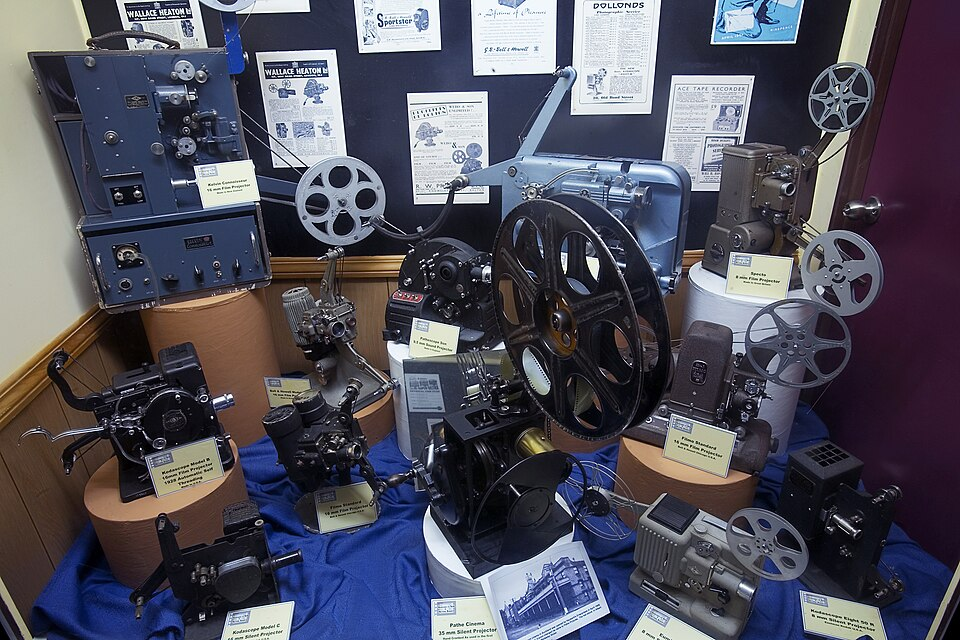
A display full of vintage film projectors and film memorabilia
The 35mm film version is definitely a good experience, as the good old film reel gives it an otherworldly vintage look. However, most scenes are set in the dark, and the projector may not be luminous enough to give you the best experience for those. Moreover, film tends to flicker at times, which can be annoying if you are not used to it. My suggestion: go for the usual digital projection or, better yet, IMAX if you are really hyped about it. You can perhaps try the Odyssey 35mm version during your rewatch.
The Odyssey: Worth the hype?
I will keep it spoiler-free, but here’s a brief review for you to decide.
TLDR: It’s good.
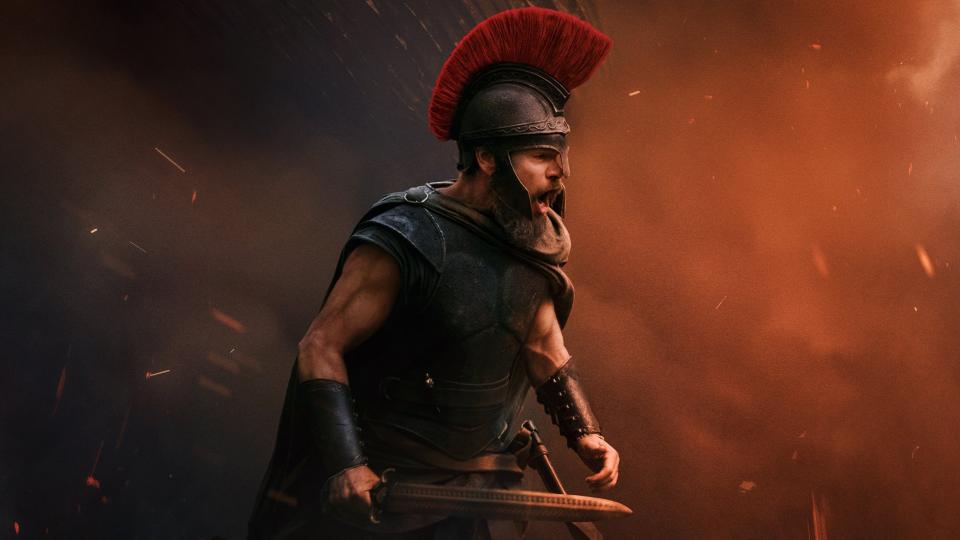
Odysseus and his men
Most of the film is filled with a nonlinear storyline (duh!? It’s Nolan). Similar to Dunkirk, the film focuses on micro-stories throughout Odysseus’ voyage and feels like an anthology with the same characters. But once again, you can’t complain because this is a mythological classic. To further add to it, most classics can have a simple plot line, so you may not go in expecting something similar to Nolan’s Inception, The Prestige or Interstellar.
Nolan is often known for his non-linear style of storytelling
However, during his voyage, most of the film is held together by the great cinematography, strong acting and direction rather than the story, which just tends to be mildly engaging. Look, don’t get me wrong, Homer’s Odyssey has some great stories, such as the fall of Troy, which we have certainly crossed paths with at some point in our lives; however, in Nolan’s adaptation, most stories don’t get enough screen time to do them justice.
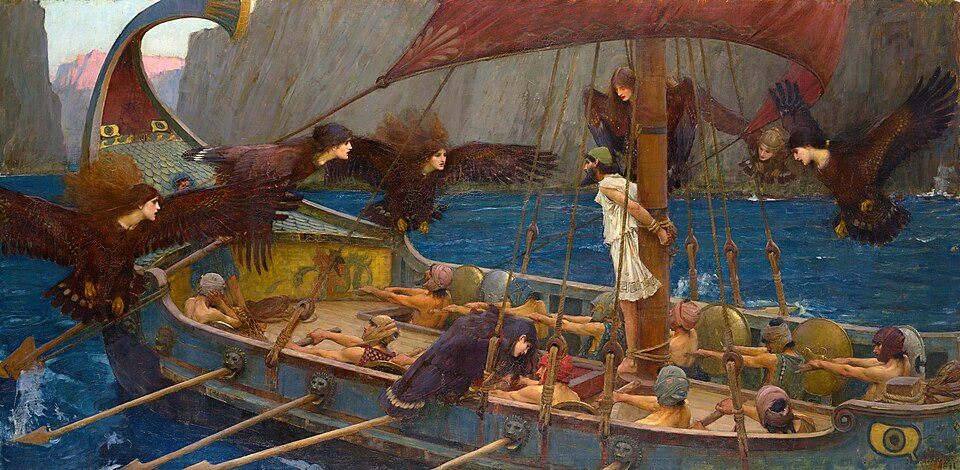
Odysseus remains tied to the mast as the sirens try to lure him and his men to their deaths
I personally was hyped to see the story about the sirens who lure the sailors to their deaths with their melodious lullaby and how Odysseus asked himself to be tied to the mast of the ship to protect himself from the deadly charm of the sirens. Unfortunately, this chapter hardly gets two minutes of screen time. Even worse, we never get to see the sirens on screen or even hear their melody, although I respect the latter choice because it needs to be more like an abstract Lovecraftian concept.
In other words, let’s just say that some stories from the Odyssey look better in that childlike, imaginative head of ours than what is being shown on screen.
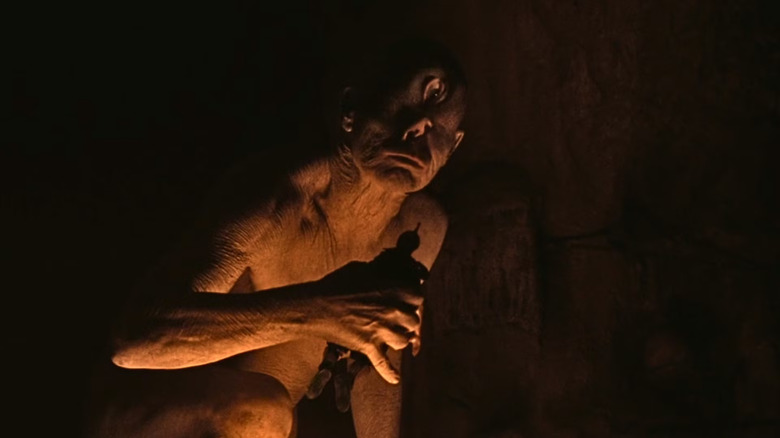
Cyclops, the son of Poseidon
And while watching the arc about the voyage, I was about to rate this a 6/10 overall, to be very honest, but the next part, the final part of the film, not only redeems it to a great extent by making the story more engaging but also makes the parallel plot at Ithaca (Odysseus’ home & kingdom) more cohesive. And in case you already know the plot of the original epic, you are in for a surprise as Nolan’s version provides a fresh new conclusion to the classic.
Verdict
Nolan’s The Odyssey is hauntingly beautiful, grand, yet imperfect.
⭐ Rating: 7/10
Go, watch it IMAX on the biggest screen possible, or The Odyssey 35mm version if you are into a more vintage style.
Originally written for Pi’s Crescendo (2020), the official student magazine of Vishwakarma Institute of Technology, Pune.
It all began with the First World War… Seeing horrors everywhere in the real world, people eventually got desensitised to the fantastical folklore and superstitious entities. When H.P. Lovecraft began writing in 1917, little did he know that he would create a revolutionary horror subgenre, one that resonated with the rapid scientific progress of his era and would shake the world for decades to come.
Very soon, his name became an adjective to refer to the particular form of terror he invoked: Lovecraftian Horror! Also called Cosmic Horror, the genre basically revolves around the fear of the unknown.
H.P. Lovecraft (Circa- Jan, 1935)
“The oldest and strongest emotion of mankind isfear, and the oldest and strongest kind offearisfear of the unknown.”
– Howard Philips Lovecraft
Imagine a scenario wherein you are hunting in an unexplored, remote forest; you are dizzy, but you keep walking further, only to realise that you have suddenly encountered a weird-looking, gigantic and gloomy cave. You stand there, terror-struck, as the dark entrance stares back at you. A moment later, you hear a low, blood-curdling growl, the one no human has ever heard before! “Darn! What in the world can make such a terrific sound!?”, you think. Whatever it is, it can’t be anything from this Earth; simply no chance! Being in the midst of the mysterious forest, you are equipped with all the ‘Hunting 101’ gear and the survival kit, yet you feel there is no choice but to flee for your safety.
So, you must be wondering: Just who or what kind of creature was inside that terrific cave? But let’s get to the real question:
Why did you run?
Or more precisely…
What made you run?!
Was it the ‘creature’ that made you run? NO, I strongly disagree! Believe it or not, it was your fault. Again, I may sound like a blame-artist, but that’s the truth, cause, frankly speaking, given the scenario, I would’ve reacted the same way. Had you known it was a mere lion, you would have shot it for sure. But what made you react in a different way in the latter scenario? The real answer is, it’s because we are afraid of the unknown. But looking again at the lion scenario, we are familiar with the existence of such a carnivore, and it wasn’t as unusual as an unknown creature letting out horrifying growls.
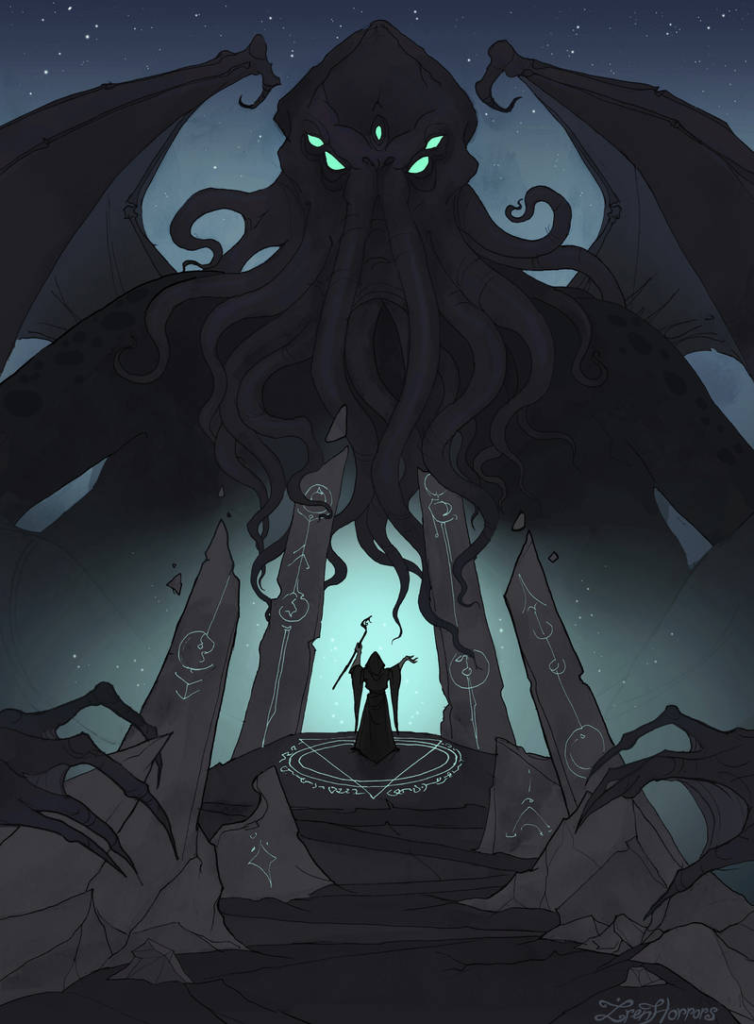
H.P. Lovecraft’s Call of the Cthulhu (Courtesy: Pixabay)
Unlike those tentacles, ghastly jump-scares, and weird makeup in the slasher genre, Lovecraft makes you dwell deeper into the depths of your mind and makes you wonder about your role in this grand scheme of things. Brace yourself for some existential crisis, and finally, you are going to realise how insignificant you are in the big wide universe! His stories take place in the same fictional continuity, known as the Cthulhu Mythos, and is filled with monstrous deities, often larger than planets, whose true motives, nature and shape remain vague or unknown. These entities are unfathomable forces that can’t be verbally described and hence, even the mere thought of illustrating them in an improper way or using bad VFX, may ruin the effect! That’s the sole reason why they’re very few purely Lovecraftian flicks. If something is difficult to describe verbally, it’s harder to recreate such an entity for the big screen!
Forget unfathomable monsters, but his writings possess the ability to invoke terror using concepts from mathematics and geometrical patterns. In the Cthulhu Mythos, the sunken city of R’lyeh is characterised by its unnatural non-Euclidean geometry! It is heavily implied this is achieved as a side effect of not following the natural laws of this universe rather than simply using an alternate geometric model, as the sheer innate wrongness of it is said to be capable of driving those who look upon it insane. If you are into Doctor Who, you must be familiar that the Doctor’s TARDIS (time-machine/spaceship which looks like a police-box) is apparently smaller on the outside but bigger on the inside and well, that’s just a brief look into the world of non-Euclidean geometry!
TARDIS: It’s bigger on the inside!
Let’s have a look at Netflix’s Bird Box, based upon Josh Malerman’s book with the same name:
Courtesy: Bird Box/Netflix
Love it or hate it, but this film is the perfect example of a Lovecraftian horror film done right! To get the gist, Bird Box is all about monsters with an unknown origin and form, which when looked at, can make people go insane and lead them to commit suicide! The clever thing about this film is the fact that they never reveal how the monsters look and it is totally left to the viewer’s imagination. As weird as it may sound, Malerman revealed in one of his interviews that these monsters were inspired by the mathematical concept of infinity! To quote his words:
“A man would go mad, lose his mind, if he were to attempt to fathom infinity… I really started thinking about and it became, like, a monstrous concept to me.”
Josh Malerman (Author: Bird Box)
So, is the personified form of ‘infinity’ the real threat in Bird Box? Something like an unexplained force, which is beyond our comprehension, enough to make us lose our sanity and leave death as the only cure? You guessed it: the real identity of those creatures will never be made clear since giving them a shape, form, or an origin will strip away all the feelings of terror associated with them! Such cosmic entities render humans into mere playthings, and the very thought of it is extremely frightening!
“The world is indeed comic, but the joke is on mankind!”
– Howard Philips Lovecraft
When faced with a threat of the unknown kind, the only thing you can do is wonder:
WHAT WAS IN THE CAVE?
If you are interested in watching a great Lovecraftian Horror film, check out: Tumbbad.
Do want a sequel to the popular Doctor Who episode: Blink, from Series 3? Or are you a Doctor Who fan who’s also into those ‘missing-mobile-phone-horror’ games? If yes, then you are definitely in for a surprise cause here we go for the Doctor Who The Lonely Assassins review!
What is it about?
A still from the PC version of The Lonely Assassins [Steam].
The story heavily involves the Weeping Angels and builds upon the events of Blink. The gameplay of Doctor Who: The Lonely Assassins involves searching for clues on Larry Nightingale’s phone, who has gone missing, and reporting the events to Petronella Osgood.
Can you play Doctor Who: The Lonely Assassins without watching the show?
YES! The only prerequisite is to watch Blink, the tenth episode of the 3rd series from Doctor Who. Of course, there are other references from the show but they have absolutely no impact on the story line and are only present as fun Easter eggs.
Where can I download Doctor Who The Lonely Assassins?
The PC version of The Lonely Assassins is available for download on Steam, Epic Games & GOG game stores. While the Android version is available here on Google Play and the iOS version is available on the Apple App Store.
So how’s the game?
The Lonely Assassins has a fun and engaging gameplay which lasts for approximately 3 and a half hours. The Weeping Angels and the actors make you feel like you are the part of the episode.
If you have played such missing-mobile-phone games before, it might be a repetitive experience for you and may hamper your ‘wow-factor’ associated with the game. The challenges are pretty easy if you have played the games of this specific genre before.
Also, if you complete all the objectives (including the optional ones), you unlock a secret ending which gives a proper closure to the story. But after watching Blink, the story feels milked and pretty obvious, yet the game manages to keep you hooked.
Pretty great for a quick-play and as a follow up to Blink!
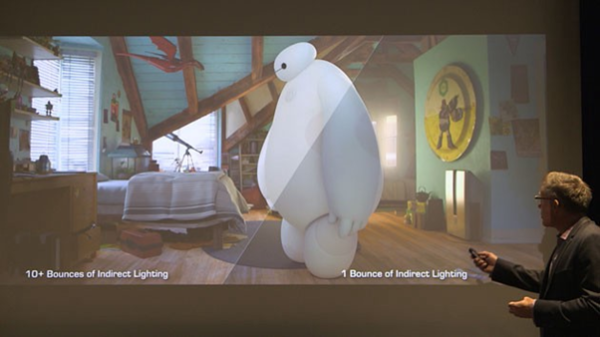
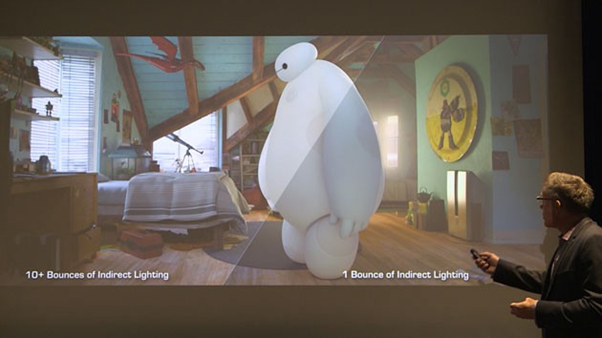
It takes around 24 hours to render each frame of a Disney-Pixar film. In fact, Pixar Animation Studios recently rendered it’s superhero-flick, Big Hero 6, on a supercomputer with 55k cores.
“We have said it many, many times. We made the movie on a beta renderer”
– Andy Hendrickson, CTO at Disney Animation
The renderer Andy referred to was Hyperion, an in-house rendering software by Pixar which could simulate real-world lightning. The lightning tricks and using the real-world data of the city of San Francisco cost them enormous render time. Therefore, they used a supercomputer cluster which was distributed across four geographic locations.
Thankfully, indie animators and small studios won’t have to do that or wait for years if they want to render their films and VFX shots.
But before we tell you that, let’s answer the following question:
What is Rendering?
Rendering is the process involved in the generation of a two-dimensional or three-dimensional image from a model utilising application programs. Rendering is necessary for architectural designs, video games, and animated movies, simulators, TV computer graphics, and style visualisation. The techniques and features used vary depending on the project. Rendering helps increase efficiency and reduce cost in design.
There are two categories of rendering: pre-rendering and real-time rendering. The striking difference between the two lies in the speed at which the computation and finalisation of images take place.
Real-Time Rendering
Image Credits: Unity
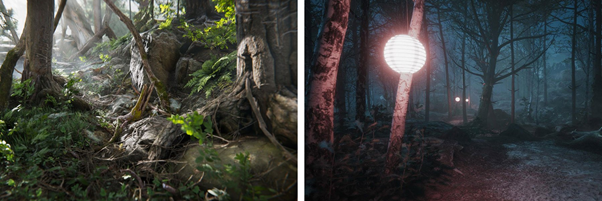
The prominent rendering technique used in interactive graphics and gaming, where images must be created at a rapid pace. Since user interaction is high in such environments, real-time image creation is required. Dedicated graphics hardware and pre-compiling of the available information have improved the performance of real-time rendering.
Pre-Rendering
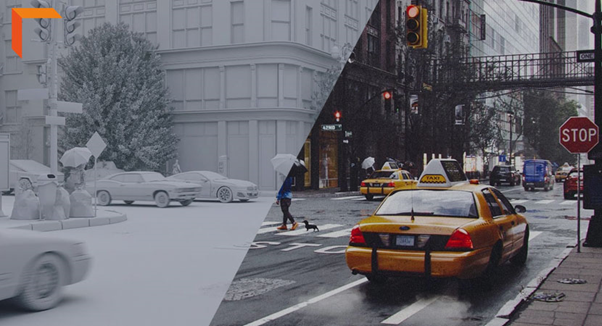
A pre-rendered still from the film Spider-Man: Far From Home
This rendering technique is employed in environments where speed isn’t a priority and therefore the image calculations are performed using multi-core central processing units instead of dedicated graphics hardware. This technique is generally utilized in animation & VFX, where photorealism must be at the very best standard possible.
Rendering for 3D/CGI Work
3D rendering is that the process of a computer taking raw information from a 3D scene (polygons, materials, and lighting) and calculating the ultimate result. The output is usually a single image or a series of images rendered & compiled together.
Rendering is typically the ultimate phase of the 3D creation process, with the exception being if you’re taking your render into Photoshop for post-processing.
If you’re rendering an animation, it will be exported as a video file or a sequence of images that can later be stitched together. One second of animation usually has at least 24 frames in it, so a minute of animation has 1440 frames to render. This can take quite a while.
There are generally considered to be two types of rendering:
CPU Rendering
GPU Rendering (Suitable for real-time rendering)
The difference between the two lies in the difference between the two computer components themselves.
GPUs are often optimized to run multiple smaller tasks at the same time, whereas GPUC generally run more complex calculations better.
Generally, GPU rendering is far faster than CPU rendering. This is what allows modern games to run at around 60 FPS. CPU rendering is best at getting more accurate results from lighting and more complex texture algorithms.
However, in modern render engines, the visual differences between these two methods are almost unnoticeable except in the most complex scenes.
CPU Rendering
CPU rendering (sometimes mentioned as “pre-rendering”) is when the pc uses the CPU because the primary component for calculations.
It’s the technique generally favoured by movie studios and architectural visualization artists.
This is due to its accuracy when making photorealistic images and the fact render times are not a considerable issue for these industries.
Although render times can vary wildly and may become very long.
A scene with flat lighting and materials with simple shapes can render out in a matter of seconds. But a scene with complex HDRI lighting and models can take hours to render.
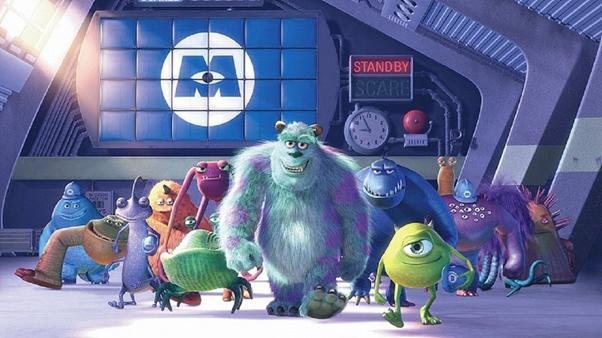
An extreme example of this is in Pixar’s 2001 film Monsters Inc.
Monsters Inc.
The main character Sully had around 5.4 million hairs, which meant scenes with him on screen took up to 13 hours to render per frame!
To combat these long render times many larger studios, use a render farm.
Render farm is a data centre with multiple GPUs/CPUs. Due to the presence of several devices, multiple frames can be rendered together. This helps reduce overall render time for films, VFX and architectural visualisations.
How long it takes to calculate one single frame highly depends on the:
complexity of the scene
render settings
available computing power
Rendering complex scenes can hence take hours.
Taking a simple scene as an example. A computer system that can calculate a simple scene in 10 seconds, still needs about 4 hours to calculate a minute-long sequence. Hence, the system will be unusable for those hours.
It’s not uncommon for a high-quality animation based on complex 3D scenes with composite lighting calculations to take up to 30 minutes of calculation per frame; Which may also lead to over-heating of the devices!
So, how do indie-artists and filmmakers make sure their sweet little devices don’t burn up in this thermal hell? Simple answer: Don’t use them for rendering! No wait, this ain’t a sick joke!
Imagine this: How good it would be to have on demand render farms on rent, available for FREE-to-negligible price? And yeah, it is possible! Thanks to the power of the ‘cloud’!
Enter: Cloud Computing!
Avatar 2 will be rendered on AWS Cloud, by WETA Digital!
Weta Digital, the VFX studio that has 6 Academy Awards for Visual Effects and has worked on blockbusters like Avatar, Avengers: Endgame and Alita: Battle Angel, has recently shifted to an AWS Cloud Render Farm for the production of Avatar 2. WETA is the largest single-site VFX Studio in the world, based in Wellington, New Zealand.
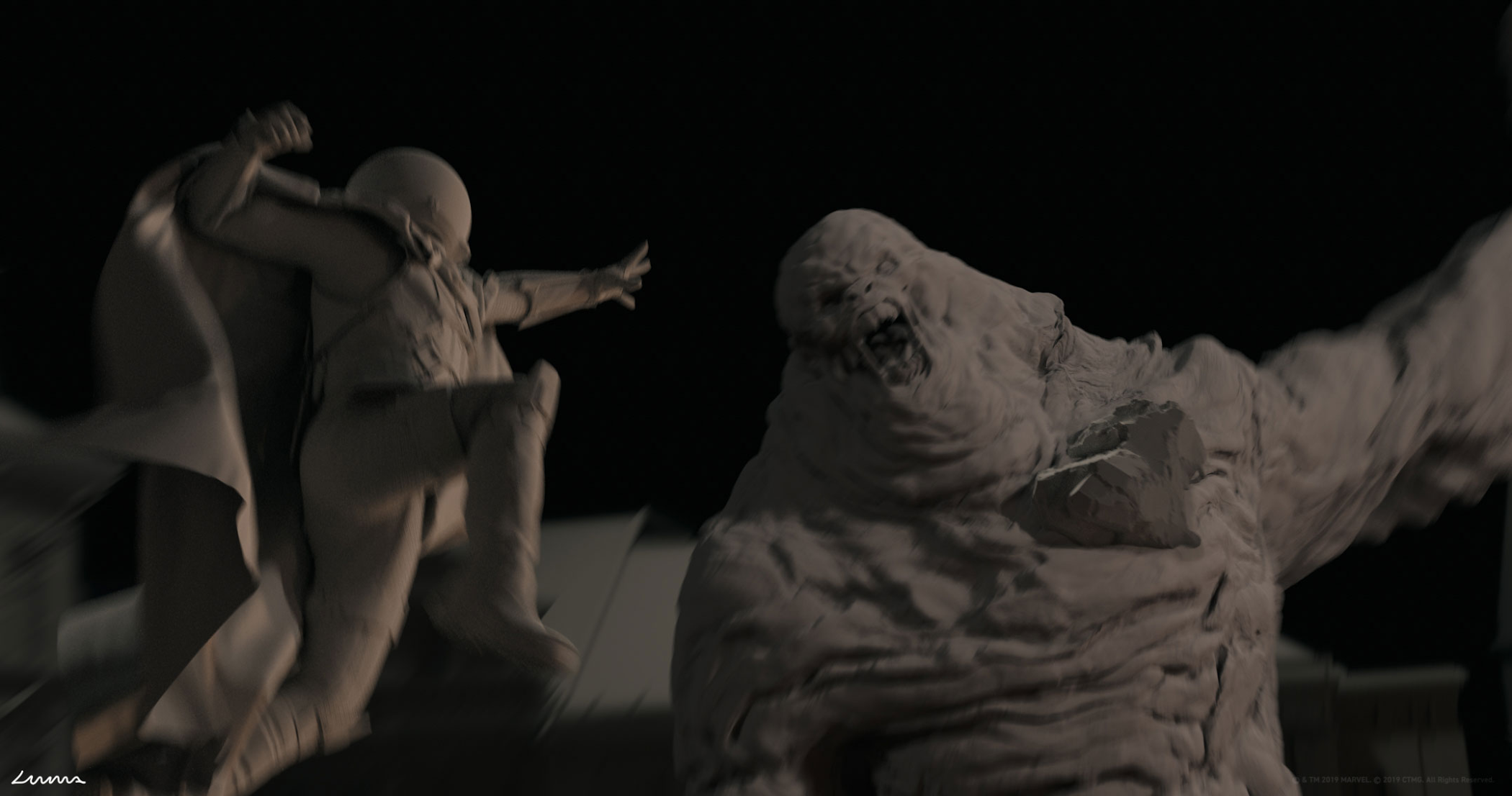
Credits: Luma Pictures/Spider-man: Far from Home
Luma Pictures decided to go for Google Cloud for rendering the VFX shots of Spider-Man: Far From Home. The probable reason for using GCP might be due to the introduction of Elementals (Earth, Water & Fire Monsters)and the notorious anti-hero known as Mysterio, who is known for his spectacular sparkling effects. The physics, fabric and fluid-particle simulations required for the portrayal of above mentioned characters could be extremely time consuming. Google Cloud reduced the render time to 1/5th of the local render-farm time, helping them deliver the movie to the audience at the right time!
How do VFX Studios render on the AWS Cloud?
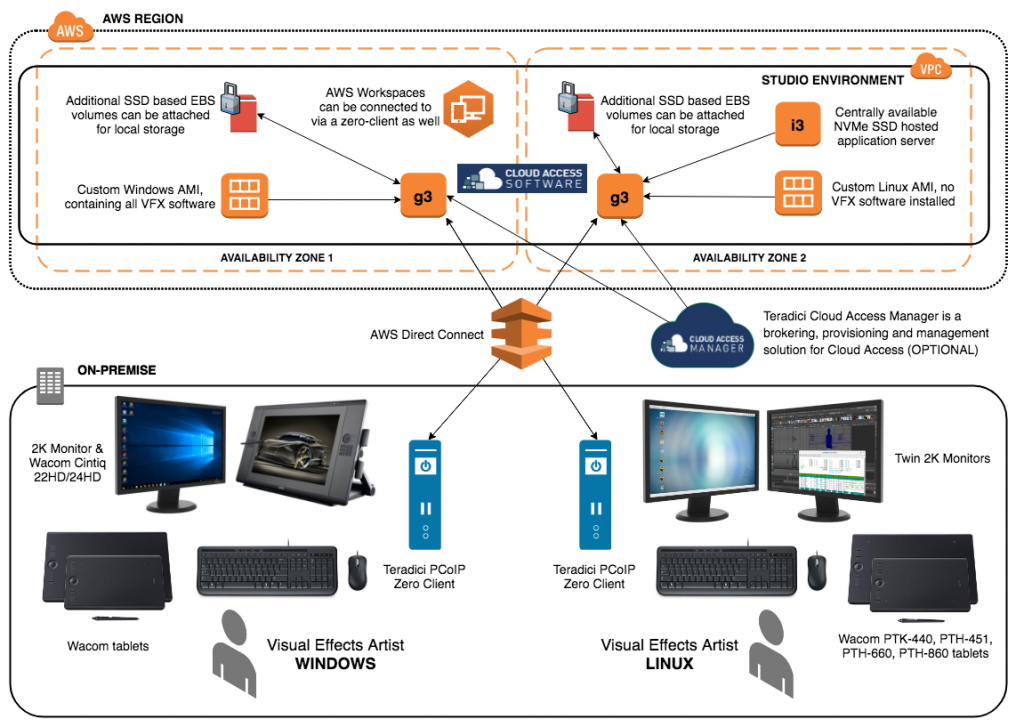
Image Credits: AWS
A Virtual Private Cloud (VPC) is created with Amazon EC2 G3 instances & SSDs. G3 instances provides access to the powerful NVIDIA Tesla M60 GPUs. AWS Direct Connect helps in connecting the on-premises workstations to the VPC.
AWS Direct Connect is a physical ethernet fiber-optics cable that connects the workplace network to the virtual private cloud. One end is connected to your internal network router and the other one is connected to the AWS Direct Connect router at their data center.
The VFX artists can work on their high-end workstations (Windows/Linux) consisting of: 2k displays, drawing tablets, keyboard, mouse and most importantly: a Teradici PCoIP Client. The PCoIP client connects them with the EC2 instances on the cloud.
Teradici is the developer of PCoIP (PC over IP). It is a Remote Desktop Protocol. These PCoIP clients help in remotely controlling the computers on the private cloud (more precisely: instances). The client can also detect input from drawing tablets, which can sense up to 8k different levels of pressure.
Fun fact: Luma Pictures now plans to install a direct connection to Google Cloud (Region: Los Angeles), which is similar to AWS Direct Connect. This will result in higher bandwidth and lower latencies, which would be beneficial for their future productions.
How can Indie Filmmakers & Studios Render on the Cloud?
Blender is a popular CGI suite among Artists & Indie Filmmakers
For smaller studios or independent animators using an open-source CGI Suite like Blender, the process might be even easier and faster. Here are a few methods for rendering on cloud using Blender:
Let’s begin with a quick-fix: use the GPU provided by Google Colab! As inefficient & silly it sounds, it’s good if you are aiming for a short animated clip lasting for a few seconds. You can directly render your ‘.blend’ file with this python script: BlenderRender.ipynb — Colaboratory (google.com)
Using AWS is extremely efficient for longer clips or physics intensive animations. Simply choose a P or G type Amazon EC2 Instance running a recent Linux AMI, and install Blender along with the necessary NVIDIA Drivers. Setup the script required to enable GPU rendering (Credits: Fajrul Falah). Google Cloud Platform setup requires similar steps.
Conclusion: Rendering can take hours and even generate a lot of heat. You can save your GPU cores from burning up and deliver the project on time, thanks to cloud rendering! Use it to the fullest! 🙂
Also, if you are preparing for the AWS Solutions Architect Associate Certification (SAA-C02), here’s a great practice test set by Neal Davis:
Although I’m not affiliated to Neal Davis and his company, but I’ve enrolled for his courses and would definitely recommend his content. Please note that these are affiliate links and I may earn a small commission from them. 🙂
I woke up to what seemed like a pretty normal day, for the year 2020. Followed the same routine, the same workout & got dressed up for work; only then, I heard a commotion outside. People were protesting, but why?
“FIND THE RECIPE! WE WANT THEM BACK!”, shouted the protesters.
Suddenly, my phone started to ring; it was Eric. “Hey Eric!”, I answered, “What’s u…”.
“Dude, stop whatever you are doing RIGHT NOW and GO, CHECK THE NEWS!”, he interrupted! “It’s 2020, we’ve already seen the World War 3, the Australian Bushfires & the Coronavirus… What else could be worse? A Kraken appearing in the sea?”, I joked as I turned on the TV and tuned to the news.
“JUST GO AND WATCH”, he replied in a serious tone. Okay now, I don’t have a good feeling about this. A grim moment awaits me as the words begin to flash on screen and I stare, open-mouthed, in horror! THIS CAN’T BE! Reading that the WORLD WAS ABOUT TO END, would have been a way better experience; but NOT THIS! This is utterly horrific! 2020 once again turned into a nightmare! Everything in eternity is about to lose it’s flavour!
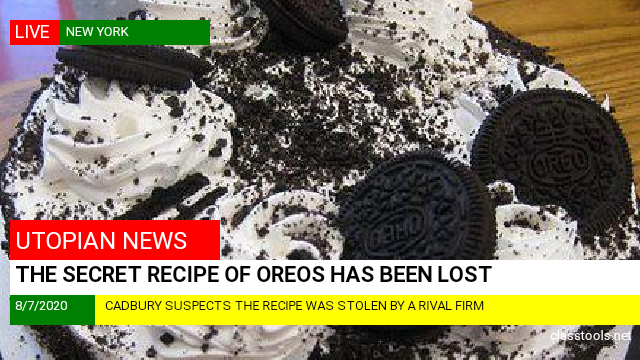
BREAKING NEWS: THE SECRET RECIPE OF OREOS HAS BEEN LOST!
Humanity has lost the very definition of versatility! No More delicious biscuits, cheesecakes, ice creams and cookies! 🍰🍨🍪
WELCOME TO A WORLD WITHOUT OREOS! 🚫🍪
THE END
I hope you enjoyed this piece of writing and it’s the first time I attempted a short horror story (okay, not-so-horror comedy 🤪). And since the entire world has stopped and we are all going through quarantine and isolation, here’s something that will prevent you from getting bored:
You would love the free month-long trial of Audible by Amazon. Audible brings you a wide range of audiobooks, which you can enjoy during your quarantine! What’s more? PRIME Members get a 90-day trial! Just hit the link down below to enjoy your free-trial which can be cancelled anytime in case you are just not into it! Even if you cancel your subscription, you get to keep the book you redeemed, so there’s nothing to lose! ❤
Guys, this ain’t another April Fool’s prank but Burger King just launched a vegan whopper which tastes totally like meat; in other words, it’s 0% meat and 100% real! The food giant recently announced it’s collaboration to test plant-based with the startup Impossible Foods, making it the biggest fast-food company to launch a vegetarian-friendly burger option to date. This is a great move by the firm since it is where the future of food lies: vegetarian stuff tasting like meat!
In the modern era of food industry, several new startups, like Beyond Meat, producing the so called ‘plant-based meat’ or ‘fake-meat’ have emerged and are abruptly disrupting the billion dollar meat industry. Technically, this seems to be a good news, judging from the environmental perspective. As humanity moves toward the new generation of meat, global warming problems will reduce significantly. And what’s more, the alternative doesn’t compromise on the taste! So be it lab-grown meat or this, we are sure progressing towards a better, eco-friendly future!
Woah, before you go, just hang on, cause this isn’t the first time Burger King tried such a wonderful collab!
They even made mcwhopper.com, a site dedicated to the whopper that never happened;
“Our invitation might be unexpected, but it’s 100 percent sincere”
-mcwhopper.com
cause this is how Steve Easterbrook, McDonald’s CEO, responded, “A simple phone call will do next time!” (posted on Facebook), maybe because it’s exactly the way you should treat someone asking you for charitable-collab to create a luscious burger on Peace Day!
Do you think plant-based meat will help in a sustainable future? I would like to know your opinion so feel free to comment below!
Thanks for reading and I hope you get the scent of sarcasm above! 😉





 TARDIS: It’s bigger on the inside!